What they’ll need at thirty
Childhood is short. What we build in it isn’t.
Seven letters about the moments that matter in the first six years, what they are building in your child, and what to do when they happen.
To read or to listen to · One payment, yours to keep
Parenting has never offered more: more books, more experts, more opinions, more things to get right.
And still, most thoughtful parents carry the same quiet question:
Am I focusing on the right things?
The Letters were written to answer that.
Written for the parent whose time is short, whose standards are high, and who has read enough.
What They’ll Need at Thirty
Seven letters, ten minutes each. Read or listen to them one per day.
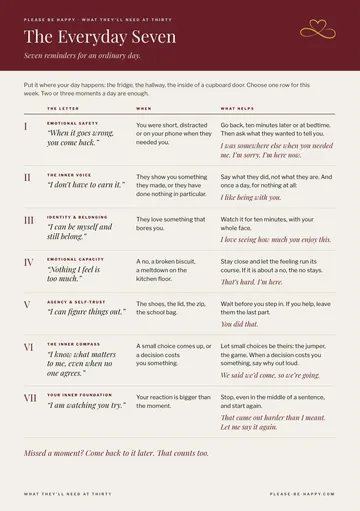
The Everyday Seven
One page for the fridge, for the moment itself.
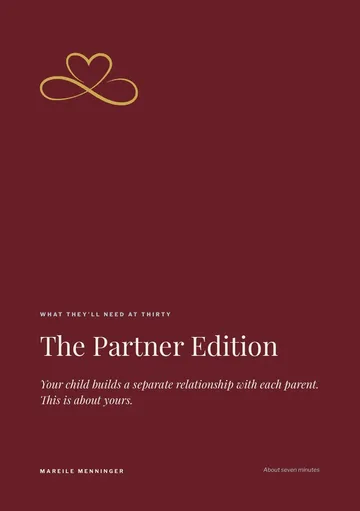
The Partner Edition
Seven minutes that start your conversation.
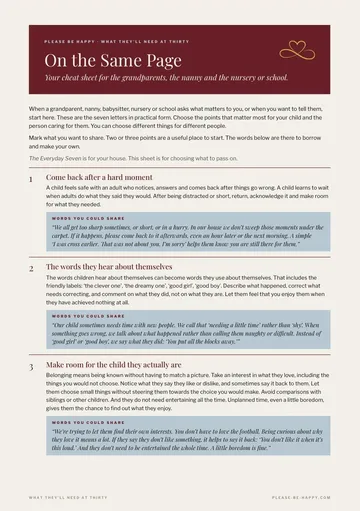
On the Same Page
Words the grandparents, nanny and nursery can use.
The Eighth Letter
Yours to write, for your child to open at eighteen.
The shift
Most parenting advice starts with what your child is doing.
The tantrum, the refusal, the not listening, the not sitting still at the dinner table or the wish that they would just put their shoes on so we can leave the house on time.
So we look for an answer to fix the behaviour.
The Letters look at something else:
What is your child concluding about themselves while it happens?
Because there are moments in ordinary family life that look small from the outside, but are answering much bigger questions for a child.
- What happens when I get it wrong?
- Am I still loved when I am difficult?
- Can I trust myself to figure things out?
- Do I have to be good at something for it to count?
- Can I be myself and still belong?
These are not questions a child answers in one moment, and none of this depends on getting every moment right. The foundations are built through thousands of ordinary experiences across the early years.
In a well-run home, things rarely go wrong through neglect. Almost everything that goes wrong there is the shadow of something being done right.
You are quick, so you put the shoes on yourself. It is faster, and the morning has to work. Add that up over a thousand ordinary moments, and a child concludes that things get sorted out around here, and they are not the one who sorts them.
You love them, so you try to fix the tears as soon as possible. Another biscuit, a quick distraction, a solution before the crying has properly started. Over time, a child learns that a hard feeling is an emergency someone else has to end.
You can keep every ambition you have for your child. The Letters ask you to look closely at the two or three moments a day where one of your strengths goes a step too far. They show you what to do there instead, to raise a child who trusts themselves, can get through hard feelings and knows they don’t have to earn your love.
There is room to notice, change and repair. And these years do not close behind you. What is being built at two is still being built at five.
Is this gentle parenting?
If you mean fewer limits, no. Warmth and clear limits belong together. When your child cries because the answer is no, you can comfort them and keep the answer. You don’t have to prevent every disappointment or stay calm all the time, and your standards stay where they are.
Why it matters
The bigger job is raising the person they will become.
For so long, parenting has focused on the child in front of us. Are they listening? Behaving? Keeping up? Ready for what comes next?
That changes what deserves our attention.
We still prepare children for the future in the ways we can see. The school. The skills. The opportunities. All of it matters.
But the world they will enter will ask for things we cannot put on a timetable: knowing what to do when there is no clear answer, recovering when something fails, changing direction, and knowing what matters when everyone else has an opinion.
And strangely, much of that preparation happens now.
A study in New Zealand followed a thousand children from birth into adulthood. At thirty-two, the ones who had been better at steadying themselves as children were healthier and more financially secure, even once intelligence and family background were taken into account. It cannot show that parents cause this. It shows what is at stake.
At four. At breakfast. During play that looks like nothing is happening. In the two minutes before leaving the house.
Those are the moments the Letters are about.
The seven Letters
Six beliefs your child takes into life. The seventh starts with you.
- I
Emotional safety
When it goes wrong, you come back.
For the child who learns that connection does not disappear when things get difficult.
At thirty trusting that a relationship can survive an argument.
- II
The inner voice
I don’t have to earn it.
For the child who can want to achieve and succeed without turning every failure into a verdict on their worth.
At thirty getting through setbacks and still speaking kindly to themselves.
- III
Identity & belonging
I can be myself and still belong.
For the child who learns that belonging does not have to come at the cost of being themselves.
At thirty walking into a room without auditioning.
- IV
Emotional capacity
Nothing I feel is too much.
For the child who learns that hard feelings can be felt and survived, without needing life to stay easy in order to feel okay.
At thirty feeling fear, anger or disappointment fully, and still deciding what to do next.
- V
Agency & self-trust
I can figure things out.
For the child who learns to try, decide and work it out before someone else does it for them.
At thirty starting before anyone has told them how.
- VI
The inner compass
I know what matters to me, even when no one agrees.
For the child who learns to hear their own voice when people, algorithms and expectations are telling them what to want.
At thirty making the decision nobody else can make for them.
- VII
Your inner foundation
I am watching you try.
The seventh Letter is about you. Because what we learned about love, success, feelings and being good enough has a way of entering the room with us when we become parents, including the parts we thought we had left behind.
Each Letter follows one of these into ordinary family life. It shows you where it is being built, what can quietly get in the way, and what to do differently when that moment comes.
After reading
What changes
The Letters do not leave you with seven more things to worry about. They give you a clearer way to decide what deserves your attention and what doesn’t, and you enjoy these years more, because not every moment has to carry the whole future.
You stop treating every difficult moment as equally important. Not every refusal, meltdown or unwanted behaviour needs to become a parenting project. You know which moments are building something your child may carry with them, and which ones can simply belong to having a small child.
You can want a lot for your child without making their worth depend on it. The school, the skills, the opportunities and the ambition can all stay. The difference is building something alongside them that is still there when they fail, change direction or life presses in.
And you start looking beyond the child in front of you to the person you are raising. Not a perfectly parented six-year-old, but someone who takes self-trust, resilience, belonging and a sense of who they are into the rest of their life.
For parents-to-be and parents of children in the first six years.
From other parents
“It’s thoughtful, warm and well written. It reads like a person talking, not a parenting manual, and it never once made me feel judged, which is rare. The idea that the things we do well cast a shadow really landed for me. We noted down a few things to try: the repair sentence, sitting beside the meltdown, and choosing two or three moments a day when I don’t step in.”
“Especially when it comes to difficult emotions, our first instinct is often to make those feelings go away. Understanding why it’s actually better to let our children work through them makes it so much easier to stay calm, be patient and support them along the way.”
“My wife sent me this, and I’ll admit my first thought was, ‘More gentle parenting?’ I listened on the way to work. I’ve always wanted my son to be confident, but I’m quick to jump in and correct him, help him, or tell him how to do something. I hadn’t really connected the two. Now I give him a little more time before I step in. When he gets frustrated, I don’t feel like I have to sort it out straight away. That’s taken pressure off me, too.”
The Letters
What They’ll Need at Thirty
- Seven letters, to read or to listen to
- The Everyday Seven, for the fridge
- The Partner Edition, for your partner
- On the Same Page, for the grandparents, the nanny and the nursery
- The Eighth Letter, with questions to help you write it
$79 USD
One payment · Yours to keep · Download link by email right after payment
Buying it for someone else? A card for your message is included.
Written by Mareile Menninger, certified in resilience for children and young people.
What you get
Seven letters, from one parent to another.
I wrote these as Letters because I did not want them to feel like another parenting manual.
They are what I wish someone had given me when my first child was still small. Something thoughtful enough to change how I saw these years, but short enough to read while I was actually living them.
There are seven, and each takes about ten minutes to read, or you can listen to them, read by me, in the evening or while you get ready in the morning. The audio is about 100 minutes in all, a spoken version written to be heard. Every Letter ends with one small thing to try in ordinary life, one question to keep, and a short note on what it looks like at two and at five.
You also receive:
- The Everyday Seven. One page for the fridge or the inside of a cupboard door, so you remember what matters when the moment comes.
- The Partner Edition. Seven minutes to read, written to stand on its own. At the end, it asks your partner to tell you which part landed, and that is where your conversation starts.
- On the Same Page. For the grandparents, the nanny and the nursery or school: the few things that matter most in your house, in words they can use. You stop explaining it all again at every handover.
- The Eighth Letter. A letter for you to write to your child, to be opened when they turn eighteen, with questions to help you start. They will have a thousand photographs of this year. What no photograph holds is how much you loved them, and the small things that were only theirs.
You can start listening on your phone right after you pay. A download link and the address of your own letters page come by email. Read one Letter a night for a week, and keep them to come back to as your child grows.
Give it as a gift
For someone who is already a good parent and thinks about it more than most: a new parent, a friend at their child’s first birthday, or anyone in the middle of the first six years.
It reads as one parent writing to another, and it comes with an eighth letter for them to write to their child, to be opened at eighteen. You get a card with the address and password of their letters page already on it. Write your message and pass it on.

The founder
Written by Mareile Menninger
For fifteen years, I worked as a journalist and editor-in-chief at major German publications, and later led communications for an international media company, close to people who had, by every external measure, succeeded.
What stayed with me was that the people who struggled were rarely short of intelligence, discipline or ambition. Many of them measured their worth by their last result, and no result felt like enough for long.
What was missing was often much quieter: the ability to fail without falling apart, to trust themselves without constant external confirmation, to know what mattered to them, and to hold ambition without being consumed by it.
It made me want to know where that begins. The question led me into years of professional training and study in human development, identity and the patterns we carry into adult life. I trained specifically in resilience for children and young people and hold a German certification in it. My work is grounded in neuroscience, psychology, behaviour and early childhood development.
When I became a parent, the question turned personal.
Over time, the same ideas kept appearing across very different fields: what matters much later in life often begins in moments that look remarkably ordinary while our children are small.
Questions
I’ve already read a lot about parenting. What will this add?
Most of what you have read is advice for a moment: what to say in a tantrum, how to handle bedtime. The Letters connect those everyday moments with what your child is learning about themselves while they happen. Once you see that, you know which moments deserve your attention and which ones you can let go.
I’ve read The First Six Years. What’s in the Letters that isn’t in the free read?
The free read shows what is being built in these years and why it matters. The Letters take each of the seven foundations into the moments where it happens, at two and at five, and show you what to do there. With them come the audio, The Partner Edition, On the Same Page and The Eighth Letter.
I barely have time to read. Will I actually use this?
Every Letter also comes as audio, read by me, so you can listen in the evening or while you get ready in the morning. Start with the one that sounds most like your house. There is nothing to keep up with, and the changes happen in moments you already have: the shoes, a no, the minute after you were short with them.
What will I actually do differently?
You’ll find it easier to judge what a moment needs from you: when to help, when to hold a limit, and when to give your child a little more room. Each Letter gives you one small thing to try. You can start in a moment that already happens every day, with a clearer sense of why it matters and less second-guessing afterwards.
Will this make me feel guilty about what I’ve already done?
Some parts may feel familiar, and a few may sting. I wrote some of them about myself. Every Letter shows you what to do next time, and none of it depends on getting every moment right. What counts is what happens again and again over the years, and that can change.
What if my partner isn’t interested in parenting books?
Then The Partner Edition is for them. It takes about seven minutes and stands on its own, so they don’t need to read the Letters or listen to your summary. At the end, it asks them which part landed, and that is a good place for the two of you to start.
My child spends a lot of time with a nanny, grandparents or nursery. Will this still help?
Yes. On the Same Page is made for exactly that. It gives you the few things that matter most in your house, in words you can pass on, and shows you how to start with what they already do well. One or two shared points are enough to begin with.
I’m pregnant. Is it too early?
It’s a good time. While everyone around you is talking about prams, sleep and which classes to book, the Letters show you what will actually matter in the years ahead. That takes a lot of pressure off from the start. Most of the examples are from children between two and five, so some of it is for later. The seventh Letter, the one about you, and The Eighth Letter are for now. The Partner Edition helps the two of you talk about what kind of parents you want to be before the baby arrives. I wish I had read the Letters when I was pregnant with my first child.
My child is already five or six. Have I missed the important part?
No. What these years build is still being built at five, and at six, and nothing in the Letters closes on a birthday. Each Letter shows what it looks like at two and at five, so you will recognise your child in it. The Letters describe what is possible from here.
Is it based on research?
Yes. The Letters draw on developmental psychology, neuroscience and attachment research, and on years of my own training in human development and in the resilience of children and young people, in which I hold a German certification. They translate that work into the moments where it shows up at home. Every source is listed at the back, with notes on where the evidence is strong and where I go further.
How do I get it?
Polar, our payment provider, emails you a download link right after payment, together with your own letters page, where you can start listening on your phone. Everything is yours to keep. Buying it as a gift? The address and the password of the letters page are already on the card, so the person you give it to has everything at once. If anything doesn’t work, write to me at hello@please-be-happy.com, and I’ll sort it out myself.

Know what matters now.
Build what they’ll need later.
To read or to listen to · One payment, yours to keep